Home

  • About C-CEBH
    • Welcome
    • What is C-CEBH?
    • Evolutionary Biology of Hearing
    • Related links
  • Faculty and Labs
    • People
      • CORE Faculty
      • NIDCD Faculty
      • Affiliated Faculty
      • Staff
    • Research Focus Areas
    • Grant Support
  • Trainees
    • Current Trainees
    • Featured Past Trainees
    • Past Trainees
  • C-CEBH Training
    • Pre-Doctoral Training
    • Post-Doctoral Training
    • Courses
    • Apply Today
  • C-CEBH / NIDCD Partnership
    • C-CEBH / NIDCD Partnership Overview
    • C-CEBH and NIDCD Joint Meeting
  • Apply Today
  • About C-CEBH
    • Welcome
    • What is C-CEBH?
    • Evolutionary Biology of Hearing
    • Related links
  • Faculty and Labs
    • People
      • CORE Faculty
      • NIDCD Faculty
      • Affiliated Faculty
      • Staff
    • Research Focus Areas
    • Grant Support
  • Trainees
    • Current Trainees
    • Featured Past Trainees
    • Past Trainees
  • C-CEBH Training
    • Pre-Doctoral Training
    • Post-Doctoral Training
    • Courses
    • Apply Today
  • C-CEBH / NIDCD Partnership
    • C-CEBH / NIDCD Partnership Overview
    • C-CEBH and NIDCD Joint Meeting
  • Apply Today
Enter the terms you wish to search for.

Art and Science of the Brain’s Response to Sound

CCEBH Banner Image of sound wave entering an ear.

In his University of Maryland lab, Nikolas Francis uses cutting-edge scientific tools and methods to analyze how we’re able to focus on a sound, recognize it and react. Ultimately, his research could help identify new therapeutic targets for the treatment of hearing disorders and advance our understanding of how we listen to sound.

Outside his role as assistant professor with joint appointments in the Department of Biology and the Brain and Behavior Institute, Francis is a percussionist in the D.C. jazz scene—but the two sides of his identity aren’t as disparate as they might initially seem. 

As an improvisational musician, keeping in sync with his fellow musicians means careful listening and instantaneous responses to their changes and cues. “Arguably, playing music is one of the heights of the listening experience,” he said.

Watch the video here!

Read the original article


Original article from https://today.umd.edu written by College of Computer, Mathematical, and Natural Sciences Staff
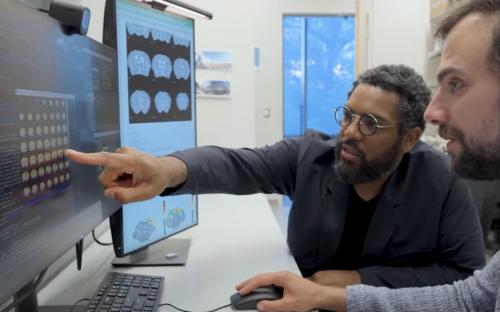
Nik Francis pointing at a computer
University of Maryland 1856 - College of Behavioral & Social Sciences

Login / Logout